Where Do ChatGPT, Google, Perplexity and Gemini Get Their B2B Recommendations? (October 2026 Study)
We asked four AI tools the questions B2B buyers ask before they shortlist a vendor, across three categories: PR agencies, cybersecurity software and CRM software. Then we logged every source each tool used. 60 answers and 552 sources later, here is what the tools read, how that changes by question and by tool, and what it means for any B2B company that wants AI tools to recommend it.
Short answer: the type of question decides what an AI tool reads. Broad and comparison questions ("best X", "X vs Y") are answered mostly from third-party list and comparison articles. Specific questions (a named guarantee, outlet or integration) are answered mostly from vendors' own pages that address that exact question. Questions about one company by name lean on review sites and independent reviews. The pattern held in all three categories and all four tools, but each tool weighs sources differently: Perplexity relies on list articles the most, Gemini on reviews, and Google is the only one that uses Reddit and YouTube to a meaningful degree. A third round on October 23 added IT services, payments and HR software (120 answers across six categories in total) and found the same pattern, plus one more: 60% of the "best X" and "X vs Y" articles that Perplexity and Google cited were published by a company selling in that same category.
How we ran the test
- Dates: round 1 on October 12, 2026 (ChatGPT, 5 PR questions); round 2 on October 16, 2026 (all four tools, 15 questions); round 3 on October 23, 2026 (all four tools, 15 new questions on IT services, payments and HR software).
- Tools: Google Search AI Overviews (US English), ChatGPT with web search in a temporary chat, Perplexity, and Gemini. All were used signed in, so some personalisation is possible.
- Questions: 5 per category, one of each type: a broad "best" question, an industry question, a specific question, a head-to-head comparison and a name check.
- Method: after each answer we asked the tool to list the full URL of every page it used, and logged each source. For Google we logged every source the AI Overview cited.
- Coverage: rounds 1 and 2, 60 answers and 552 sources; round 3, 60 answers and 498 sources. In total, 120 answers across six B2B categories.
- Round 3 method: for Perplexity and Google we logged the full source list. ChatGPT and Gemini now show citations as labeled chips rather than links, so for those two tools we classified each source by its name (vendor site, third-party publisher, review site or forum). Gemini answered 3 of the 15 round 3 questions without citing any source.
- Source types are classified from the URL (list or comparison article, vendor's own page, review site, review article, forum or video, news or reference), so the percentages below are approximate.
- We re-run the same questions every month and update this page.
Get a free article about your company on The Tech Tier. Usually live in minutes.
Get my free articleFinding 1: the question type decides the source type
For a broad question, an AI tool recommends the companies that appear again and again across round-ups. For a specific question, it cites whoever has a page that answers it plainly, with terms and proof. When someone asks about you by name, the verdict rests on what reviewers and other people say.
| Question type | Example | What the four tools read most |
|---|---|---|
| Broad | Best CRM for B2B companies | List articles (about 48%) and vendor pages (about 46%) |
| Specific | Which EDR vendor offers a ransomware warranty? | Vendors' own pages answering that exact question (about 77%) |
| Comparison | CrowdStrike vs SentinelOne | Comparison and list articles (about 61%) |
| Name check | Is Pipedrive a good CRM? | Review sites and review articles (about 38%), plus forums |
Finding 2: each AI tool leans on different sources
*ChatGPT adds a homepage link for every company it names, which inflates its vendor-page share. Its underlying recommendations for broad questions still came largely from list articles: for "best tech PR agency for enterprise software companies" in round 1, 11 of its 15 sources were list articles.
Perplexity draws more than half of its sources from list articles, so being included on third-party round-ups matters most there. Gemini gives reviews the most weight. Google is the only tool where Reddit, Spiceworks and YouTube show up often, mostly for comparisons and name checks.
| Tool | Sources logged | List and comparison articles | Vendor and company pages | Reviews | Forums and video |
|---|---|---|---|---|---|
| Google AI Overviews | 165 | 30% | 49% | 8% | 12% |
| ChatGPT | 152 | 16% | 76%* | 7% | 2% |
| Perplexity | 154 | 58% | 36% | 6% | 1% |
| Gemini | 81 | 40% | 42% | 18% | 0% |
Finding 3: specific pages get named, broad lists decide the rest
We tracked our own agency as a test case. For "Which PR agency can guarantee my tech company gets published on Business Insider?", Google, ChatGPT and Perplexity all named Jamco PR, citing our dedicated pages that spell out the guarantee and what happens if a placement doesn't publish. In round 1, a week earlier, ChatGPT had not named us for the same question. Gemini answered it from other placement providers' pages.
For the broad questions ("best PR agency for B2B tech", "enterprise software", "SaaS"), the tools often cited our comparison pages as sources but recommended the agencies that appear across many independent lists. Specific pages win specific questions; third-party lists still decide broad ones.
Asked about us by name, all four tools described us accurately. ChatGPT's caveat was that independent evidence, such as the number of reviews, was still limited.
Round 3: six categories, same pattern
On October 23 we asked the same five question types about three more B2B categories: IT services, payments and HR software. The question type still decided the source type.
| Question type | Round 2 (PR agencies, cybersecurity, CRM) | Round 3 (IT services, payments, HR software) |
|---|---|---|
| Broad "best X" | About half list articles | 53% third-party articles |
| Specific (a named capability or guarantee) | 77% vendors' own pages | 74% vendors' own pages |
| Comparison "X vs Y" | 61% list and comparison articles | 47% third-party articles, 45% vendor pages (vendors now publish their own comparison pages) |
| Name check ("Is X good?") | Reviews weighed most | 24% review and directory sites, the highest of any question type |
Most "independent" lists AI tools cite are written by competitors
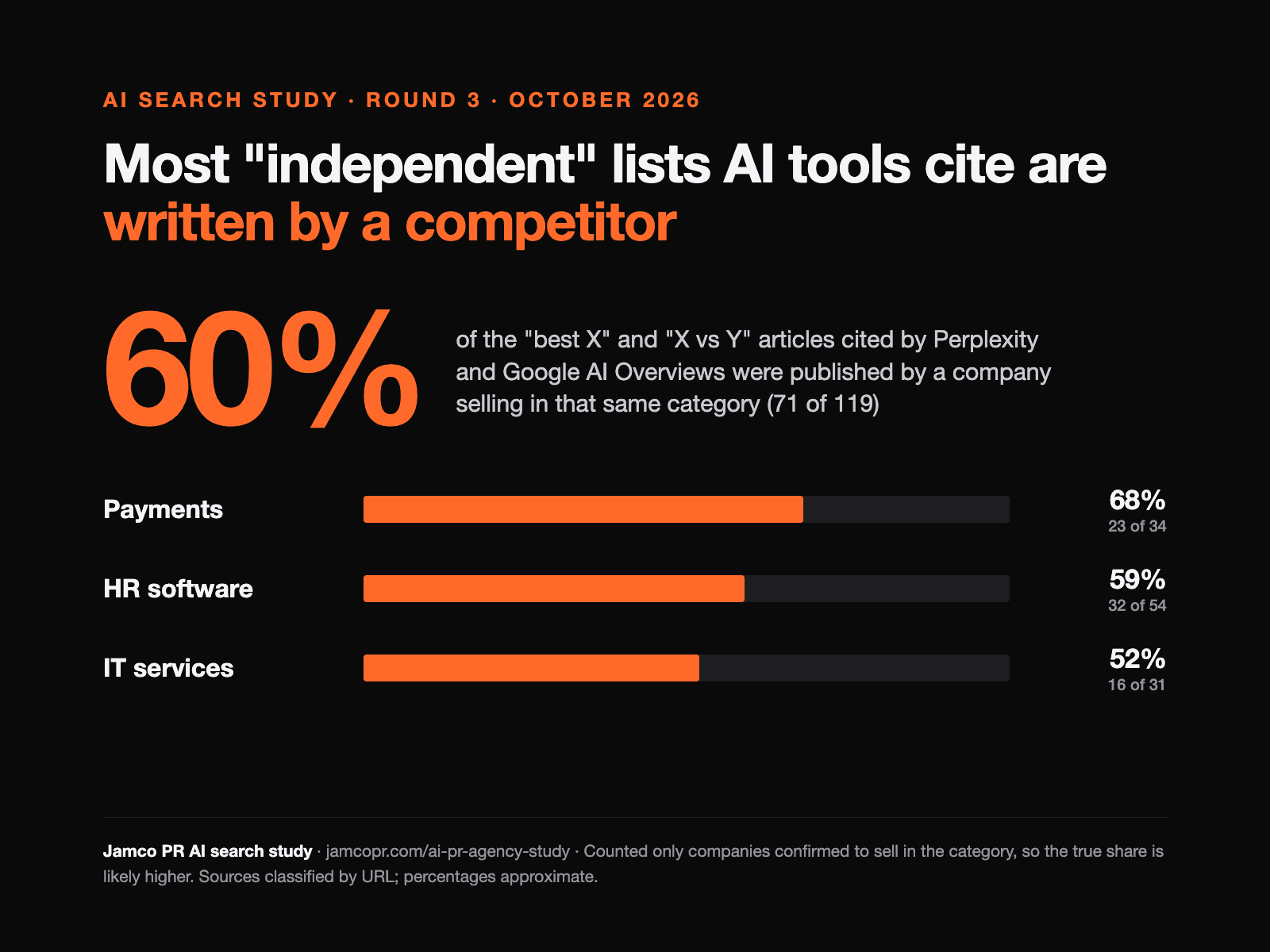
Of the 119 "best X", "top X" and "X vs Y" articles that Perplexity and Google AI Overviews cited in round 3, 71 (60%) were published by a company that sells in that same category: managed IT providers ranking managed IT providers, payment companies ranking payment gateways, and HR platforms ranking HR software. One HR platform's blog was cited 10 times across 4 HR answers. We counted only companies we could confirm sell in the category, so the real share is likely higher.
The round-ups AI tools treat as neutral are often a competitor's content marketing. Companies that publish honest comparison pages for their own category get cited; companies that don't are described by their competitors. The sources competitors can't write are reviews, independent lists and coverage on established publications.
Update: tracking the same questions week by week
After the study, we published pages that answer the exact questions buyers ask, then re-ran four of the PR questions in all four tools: best PR agency for B2B tech, enterprise software PR, which agency can guarantee Business Insider, and SaaS PR for top-tier coverage. That's 16 answers each time.
| Date | Answers recommending Jamco PR | What changed |
|---|---|---|
| October 16 | 3 of 16 | Baseline, during the study |
| October 20 | 7 of 16 | Four days after publishing pages that answer specific buyer questions |
| October 23 | 8 of 16 | ChatGPT dropped one answer and added another; Perplexity and Gemini each added one |
- Specific questions moved first. The guarantee question now names Jamco PR in all four tools.
- The broad question ("best PR agency for B2B tech") still doesn't name us in any tool. It depends most on independent lists, and it moves slowest.
- Answers change week to week, so measure on a schedule rather than once.
What this means for B2B companies
- Get onto the lists your buyers' broad and comparison questions draw from. Ask each AI tool your category's "best" and "vs" questions, collect the sources, and work on being included in those pages. This matters most for Perplexity.
- Publish one specific page per real buyer question, with terms, numbers and proof. Specific pages are what AI tools cite for specific questions.
- Build reviews and independent coverage on purpose. They decide what AI tools say when someone asks about you by name, and Gemini weighs them most.
- Don't ignore forums and video if Google matters to you: Reddit and YouTube threads shape its comparison and name-check answers.
- Keep your company facts consistent everywhere AI tools look: your site, LinkedIn and every directory or review profile.
- Measure it monthly in each tool your buyers use, because the tools read different sources.
Related guides
Free tool: who wrote this "best X" list?
Paste any "best X" list and its URL to see whether the publisher ranks itself, then run a 7-question fairness check. It runs in your browser; nothing is stored.
Recent client results
Real Jamco PR placements you can read today. Most clients see their first article within 14 days.
Know a tech company that needs this? Refer them and earn 10% of their first payment.
Frequently asked questions
Where do AI tools get their B2B recommendations?
In our October 2026 study of 60 answers and 552 sources across ChatGPT, Google AI Overviews, Perplexity and Gemini, it depended on the question. Broad and comparison questions were answered mostly from third-party list and comparison articles, specific questions from vendors' own pages, and name checks from review sites and review articles.
Do ChatGPT, Gemini, Perplexity and Google use the same sources?
No. Perplexity drew about 58% of its sources from list articles, Gemini gave reviews the most weight (about 18%), and Google was the only tool that regularly cited Reddit and YouTube (about 12% of its sources).
Does ChatGPT read company websites?
For broad questions, it relies mainly on third-party lists. For specific questions, such as which agency can guarantee a Business Insider placement or which EDR vendor offers a ransomware warranty, the tools cited the companies' own pages that answered that exact question.
How can a B2B company get recommended by AI tools?
Get included on the third-party lists the tools draw from, publish specific pages that answer real buyer questions with proof, build reviews and independent coverage, and keep your company facts consistent everywhere.
How was the study run?
We asked B2B buyer questions in four AI tools (ChatGPT, Gemini, Perplexity and Google AI Overviews), logged every source each answer used, and classified the sources by type. Rounds 1 and 2 (October 12 and 16, 2026) covered PR agencies, cybersecurity software and CRM software; round 3 (October 23, 2026) added IT services, payments and HR software: 120 answers across six categories. We repeat it monthly.
Are the "best X" lists AI tools cite independent?
Often not. In round 3 of our study, 60% of the "best X" and "X vs Y" articles that Perplexity and Google AI Overviews cited were published by a company selling in that same category. Reviews, independent lists and coverage on established publications are the sources competitors can't write.
More guides
Client case studies
Our services
Start with a free article
A free article about your company on The Tech Tier, usually live in minutes.
Get my free articleBook a call